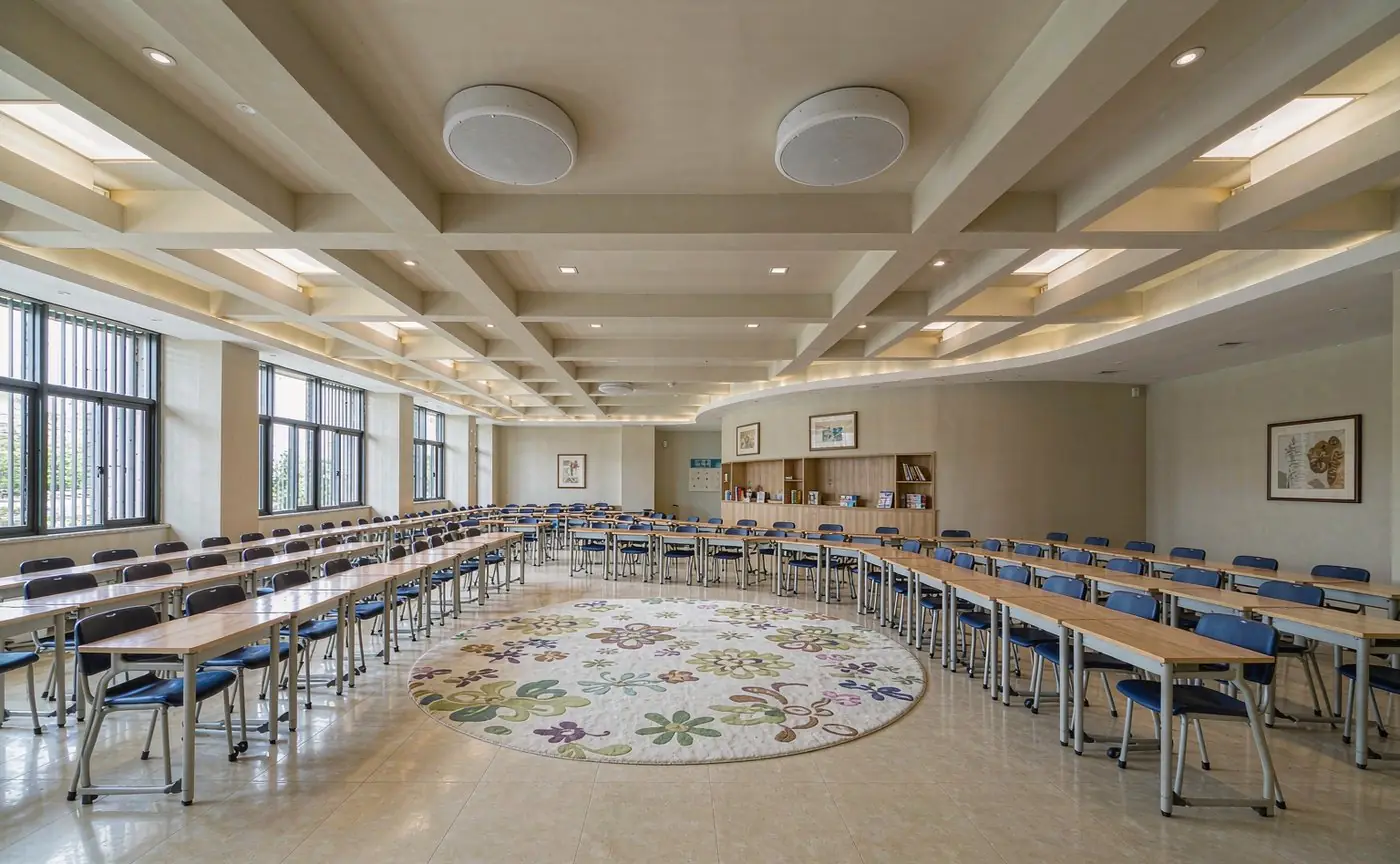
Thirty rooms, four buildings and a timetable that changes every 40 minutes. Zone by floor, not by building — and make the bell schedule as reliable as the emergency call.
A campus is not one room — it is thirty rooms, four buildings, a playing field and a timetable that changes every 40 minutes. The system has to deliver the right announcement to the right block at the right second, and still be the thing people trust when there is a real emergency.
The most common cost mistake is zoning by building when the school actually pages by floor. A building-level zone means a message for one class interrupts eight others, so staff stop using the system and go back to the WhatsApp group. The second most common mistake is the opposite: a zone per classroom, which multiplies amplifiers and cable and blows the budget for no operational gain.
The workable middle, which we specify on most campuses:
| SIP network audio | 100 V line | |
|---|---|---|
| Best when | The campus has structured cabling, or is being built / refurbished with it | Cabling is existing, or the budget is the binding constraint |
| Per speaker | PoE from the switch — one cable for power, audio and control | Two-core line from a zoned amplifier; power at the amplifier |
| Zoning | Software. A zone is a group, changeable without touching cable | Physical. Each zone needs its own amplifier channel and cable run |
| Expansion | Plug another speaker into the switch | Re-tap the line, or add an amplifier channel |
| Typical fit | New build, multi-building campus, IP telephony already in place | Single building, retrofit, tight capital budget |
For a network campus we specify the SIP-200 platform with ES-S30SO wall speakers in corridors and ES-60SO horns on the field, controlled from an ES-3001 console. For a retrofit we specify EG series mixer amplifiers with EP-10F zone editors and EX series ceiling or wall speakers.
Every campus system is judged on whether the bell rings at the right time on the right day. Points worth writing into the specification:
Where a campus also carries a fire detection system, the PA is normally expected to deliver the evacuation message. That changes three requirements: the audio path must be monitored, the emergency source must override everything else, and the system must fail in a known direction.
On a SIP campus the alarm API and the priority stack handle the override — an alarm signal interrupts music and bells and pushes the evacuation message to the mapped zones before anything else can play. Where a formal voice alarm certificate is required, we specify the EN series EVAC controllers instead, which are built as dedicated evacuation equipment with monitored lines rather than as a paging system with an alarm input.
Be honest about the standard. EN 54-16 certification is a property of a specific product configuration, not of a brand. Before a tender commits to EN 54, ask the supplier for the certificate number and the exact model list it covers. We will tell you which of our models are covered and which are not, in writing.
| Area | Target speech level | Notes |
|---|---|---|
| Classroom | 65–70 dB(A) | Measured with the room empty; the teacher must be able to talk over it without raising their voice |
| Corridor | 70–75 dB(A) | Uniformity within ±3 dB along the corridor length |
| Canteen (occupied) | 78–82 dB(A) | Set 10 dB above measured crowd noise, then verified with the room full |
| Playing field | 85 dB(A) at the far touchline | Horn height and aim matter more than amplifier power |
| Intelligibility | STI ≥ 0.50 in teaching areas | STIPA, minimum three positions per zone |
Usually not, and the money is better spent on corridor coverage plus a help-point button in each classroom. Most classroom announcements are actually corridor announcements — 'class 3B to the office' — and a corridor speaker reaches the door. Where a classroom does need its own audio, it is normally for multimedia teaching, which is a different system with different requirements.
Yes. The scheduler holds independent calendars, so the primary section and the senior section can run different period times from the same controller, and either can be suspended for exams or holidays without affecting the other.
Through a dry-contact input or a network API. On alarm, the PA switches to the pre-recorded evacuation message for the affected zones and blocks all other audio until the alarm clears. Whether that is acceptable as the primary evacuation path depends on local code — in many jurisdictions a certified voice alarm product is required, and we will say plainly whether the proposed model carries the certificate.
Standard paging systems stop when mains power stops, which is why evacuation systems are specified with battery backup. If the campus PA is also the evacuation path, specify the battery-backed EVAC controller rather than adding a UPS to a paging amplifier — the monitored line supervision matters as much as the battery.
On a SIP system, yes — the platform is rated well beyond a single campus, and a new building is a new set of PoE speakers on the same network with new zone groups in software. On a 100 V system, check spare amplifier capacity and spare cable pairs at design stage; that is the cheap moment to leave headroom.
Typically three to five working days for installation and two for commissioning and tuning, assuming cabling is in place. The schedule pressure is almost always the timetable configuration, not the hardware — allow a full day with the school's own staff to load and verify calendars before handover.
